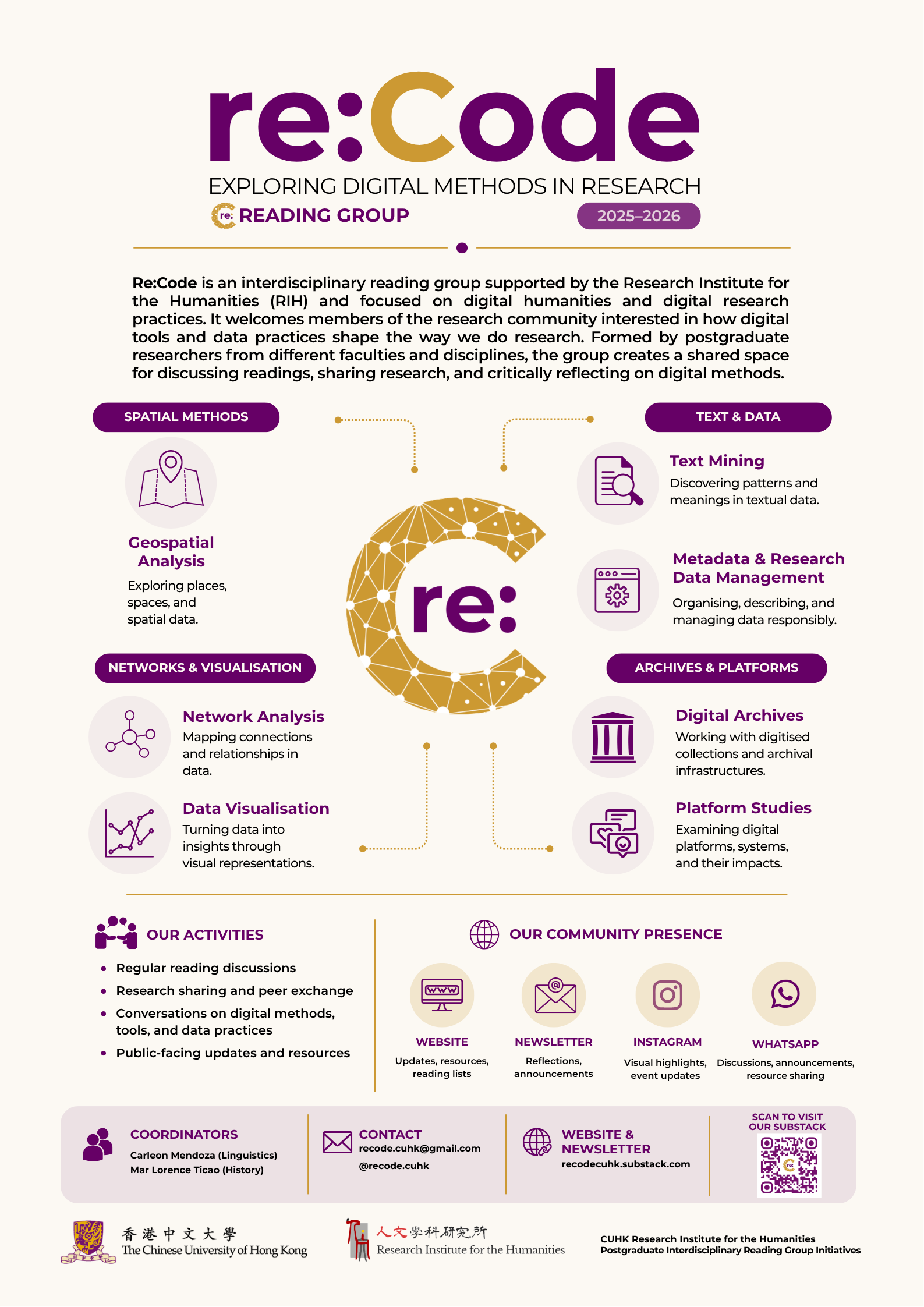
Re:Code – Exploring Digital Methods in Research
A RIH sponsored RPg Interdisciplinary Reading Group
Re:Code is a cross-disciplinary reading group that brings together research postgraduate students from the arts, humanities, communication, sciences, and engineering to critically reflect on how digital tools and data practices shape the way we do research. Instead of providing technical training, the group focuses on exploring topics such as geospatial analysis, text mining, metadata design, data visualization, and platform studies. Our aim is to create a shared, collegial, and practice-aware environment for dialogue, where we can exchange insights, questions, and challenges related to the digital methods we use or encounter in our respective fields.
Reading List:
1. Armaselu, Florentina, Gioele Barabucci, Raffaella Biscioni, Chiara Bonacchi, Sandra Camarda, Thomas Cauvin, Priya Chhaya, et al. Handbook of Digital Public History. Edited by Serge Noiret, Mark Tebeau, and Gerben Zaagsma. München; De Gruyter Oldenbourg, 2022.
A comprehensive overview of digital tools and platforms in public history, including crowdsourcing, digital archives, storytelling, and user engagement. Relevant for those among us working on public histories or whose research interests include public-facing digital work.
2. Berry, David M., ed. Understanding Digital Humanities. Houndhills, Basingstoke, Hampshire: Palgrave Macmillan, 2012.
A collection of critical reflections on digital humanities, examining its theoretical foundations, political stakes, and epistemological challenges. Serves as a strong starting point for collective discussion about the field itself.
3. Dawson, Catherine. A-Z of Digital Research Methods. London: Routledge, Taylor & Francis Group, 2020.
An encyclopedia-style reference covering a wide range of digital research tools and terms—from text mining to sentiment analysis—explained in accessible language. To be used as a reference for the group when specific methods come up in readings or discussions.
4. Drucker, Joanna. The Digital Humanities Coursebook: An Introduction to Digital Methods for Research and Scholarship. Abingdon, Oxon: Routledge, 2021.
An accessible guide to key digital humanities methods, including data modeling, visualization, text analysis, and critical data literacy, with a strong emphasis on interpretative, humanities-based approaches.
5. Gubrium, Aline, and Krista Harper. Participatory Visual and Digital Methods. Walnut Creek, California: Coast Press, 2013.
Introduces participatory research methods using visual and digital tools such as photovoice and digital storytelling. Grounded in community-based and qualitative traditions, it highlights ethical and collaborative dimensions of digital research.
6. Jockers, Matthew Lee. Macroanalysis: Digital Methods and Literary History. Urbana, Chicago: University of Illinois Press, 2013.
A foundational work in digital literary studies that introduces large-scale text analysis (“distant reading”) to explore literary trends, genres, and authorship through data-driven methods.
7. Snee, Helene, ed. Digital Methods for Social Science: An Interdisciplinary Guide to Research Innovation. London: Palgrave Macmillan, 2016.
Chapters by Claire Hewson and Jo Hope explore ethical challenges in digital research and mixed-mode methods to expand research participation, offering practical insights into inclusive and responsible digital practice.
Activities:
-
- Themed discussions based on selected readings
- What are Digital Methods and Why Do They Matter?
- Scale and Distance in Digital Humanities
- Participatory and Visual Methods
- Tool Criticism and Data Reflexivity
- Public Humanities and the Ethics of Sharing
- Occasional lightning talks by members to relate readings to their research
- Collaborative meetings with guest speakers
- End-of-year session for reflections
- Themed discussions based on selected readings
Website: https://recodecuhk.substack.com/p/finding-meaning-in-data
Contact:
If you are interested to join us, please contact the group coordinator, Carleon MENDOZA (PhD student, Department of Linguistic, CUHK) Email: mendozacarleon@link.cuhk.edu.hk
All are welcome!